1.How much does an AHU cost for a company with an area of approx. 500–1000 m²?
In practice (estimated net prices):
- Small office unit (2,000–3,000 m³/h): from 25,000 to 45,000 PLN.
- Medium production unit (5,000–10,000 m³/h): 60,000 to 120,000 PLN.
- Large installations (halls, warehouses): 150,000 to 300,000 PLN, depending on heat recovery type, automation, and insulation.
Installation costs (ducting, control systems, commissioning) typically account for 30–40% of the device price. Example: A complete 2024 installation for an 800 m² hall with heat recovery cost approximately 110,000 PLN gross.
2.How much energy can be saved through heat recovery (recuperation)?
- A well-matched unit with a cross-counterflow or rotary heat exchanger can recover 60–85% of the energy from exhaust air.
- In practice: An office building (2,500 m³ volume) previously lost approx. 60 MWh/year via ventilation. After installing an AHU with heat recovery, this dropped to 20–25 MWh/year.
- Savings: Approx. 20,000–25,000 PLN annually (based on energy prices of ~1 PLN/kWh).
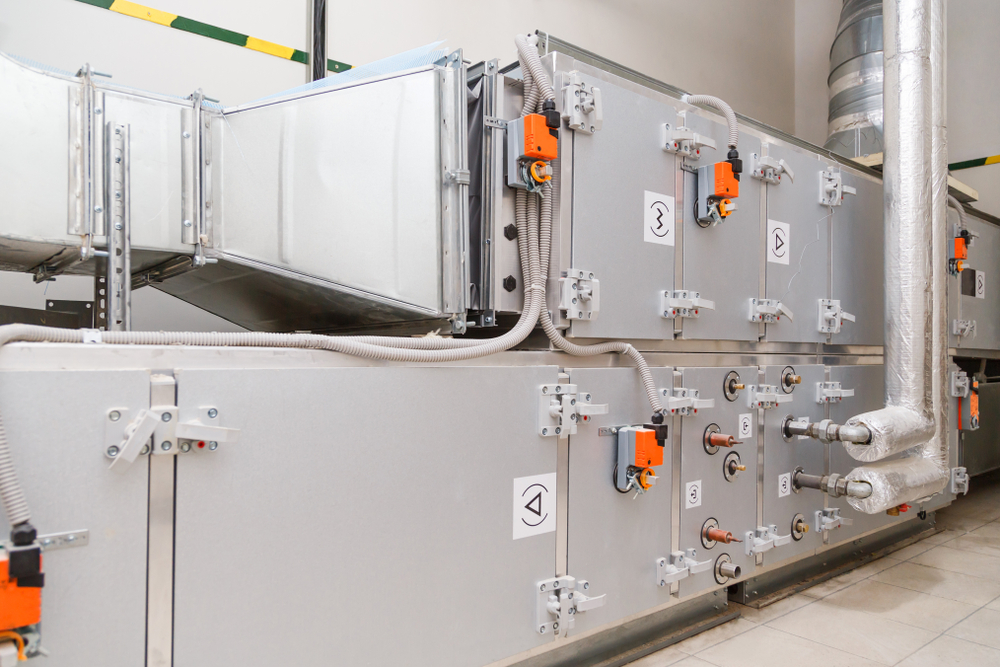
Return of investment: Approximately 4 years, depending on usage and automation quality.
3.Does an AHU consume a lot of electricity?
Not if it is correctly sized. Modern EC (Electronically Commutated) fans consume 30–50% less energy than old AC motors. For a medium unit (5,000 m³/h):
- Power consumption: 1.5–2.5 kW.
- Cost: Approx. 600–800 PLN/month (based on 10 hours of daily operation).
- Note: Poor selection (undersized/oversized unit or too high external static pressure) can double these costs.
4. What are the operating and service costs for AHUs?
The main expenses are filters and technical inspections.
- Filters: Replaced every 3–6 months (approx. 150–500 PLN per set).
- Annual service: (Cleaning, measurements, reporting) – 600–1,500 PLN.
- Repairs: Rare for high-quality devices; usually occur after 7–10 years.
- Total: Average annual operating cost is approx. 1–3% of the unit's value.
5. Can ventilation be combined with a heat pump or AC to lower bills?
Yes, this is becoming standard. Units with enthalpy recovery or integrated heating/cooling modules work seamlessly with air-to-air or air-to-water heat pumps.
- Effect: Reduces reheating demand by 20–30% and improves summer comfort (coolness recovery).
6. Are there subsidies or tax breaks for heat recovery investments?
Yes. Companies can often utilize EU funds (e.g., FENG in Poland) or energy efficiency premiums. Additionally, energy-intensive enterprises can apply for White Certificates (energy efficiency audits). Example: A company that installed an AHU in a 1000 m² hall in 2023 received a 25% cost refund through White Certificates.
7. How long is the payback period for a heat recovery unit?
Based on our experience:
- Offices and Halls: 2.5 to 5 years.
- Catering/Restaurants: 3–4 years.
- Schools/Kindergartens: Often under 3 years (due to all-day operation). After this period, the unit generates "pure profit" through significantly lower heating bills.
8. Which common mistakes increase operating costs?
From a service perspective:
- Undersized ductwork: Leads to higher resistance and power consumption.
- Lack of automation tuning: Running the unit at 100% capacity at all times.
- Clogged filters: Can increase energy consumption by 15–20%.
- Skipped inspections: Leads to a 10–15% drop in heat recovery efficiency.
9. How can I cheaply improve the efficiency of existing ventilation?
- Replace AC motors with EC motors.
- Add CO₂ or humidity sensors (Demand-Controlled Ventilation).
- Seal the ducts (leaks often cause 10–15% energy loss).
- Modernize automation: A simple controller with a weekly schedule can save 10–20% annually.
10. Is it worth investing in a rotary exchanger instead of a cross-flow one?
In facilities with high humidity (halls, catering, pools) – definitely yes. A rotary exchanger recovers both sensible heat and moisture:
- It prevents air from drying out in winter.
- It offers efficiency up to 85–90%.
- It typically sees a faster Return of investment (approx. 2–3 years).
Ratherm delivers the best air handling units for reducing operating costs and ensuring high profitability. For more information contact one of our specialists.
